Why a Custom Backyard Playground Is Worth Every Dollar
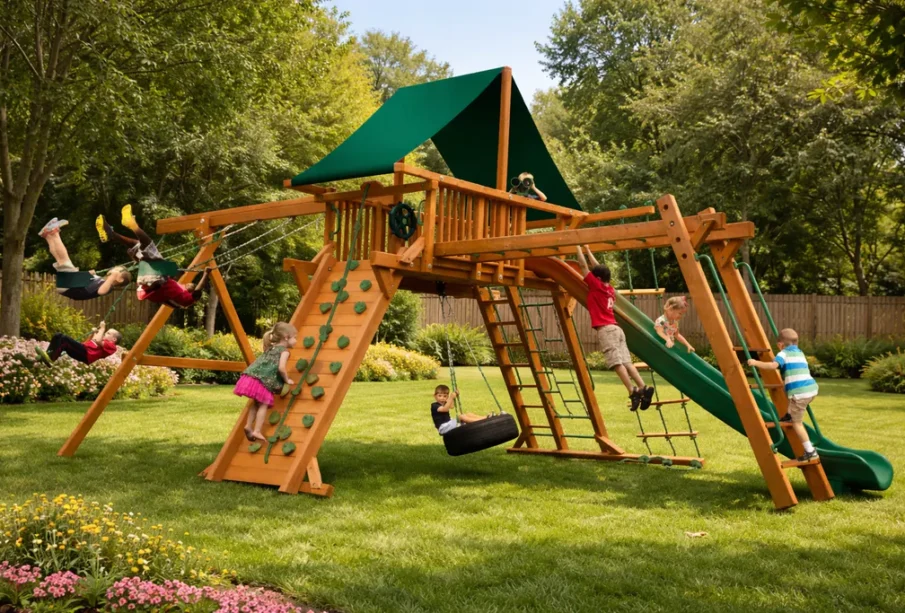
Walk past any primary school at recess and you’ll see it immediately: kids gravitate to the equipment that challenges them. The climbing frames, the swings, the monkey bars — that’s where the energy goes. The flat grass sits largely empty. It turns out children aren’t hard to motivate when the right environment exists.
The same principle applies at home. A well-designed backyard playground doesn’t just fill space — it fundamentally changes how children spend their afternoons, their weekends, and their school holidays. And with the range of customisable options now available to Australian families, building a backyard setup that genuinely suits your children and your space is far more achievable than most parents realise.
One size has never really fit all
The traditional approach to backyard play equipment was simple: pick something off the shelf, assemble it on a Saturday, and hope the kids like it. That model still works for many families — but it comes with obvious limitations. A pre-configured structure might be too small for an older child, too large for the available yard, or simply missing the one feature your children would actually use most.
The shift toward customisable outdoor playground equipment has changed this significantly. Rather than compromising between what’s available and what you actually want, families can now configure equipment around their yard dimensions, their children’s ages, and the specific activities they want to support. That means less wasted spend on features nobody uses, and more of the budget going toward what genuinely gets the kids outside.
It also means equipment that lasts longer. A structure sized and configured for your children — rather than a hypothetical average child — is more likely to remain challenging and engaging as they grow, rather than being outgrown within a couple of years.
Monkey bars that match your kids, not a catalogue
Of all the equipment parents can add to a backyard, monkey bars consistently deliver the strongest return in terms of physical development. Upper body strength, grip, coordination, and the kind of persistence that comes from repeatedly attempting something genuinely difficult — monkey bars build all of it.
The ability to customise monkey bar sets takes this further. Bar spacing, height, frame length, additional attachments like gymnastic rings or a trapeze bar — these variables matter more than most people realise. A set configured for a five-year-old will frustrate a ten-year-old. A set built for older children will intimidate a younger one. Getting the configuration right from the start means the equipment grows with the child rather than against them.
It’s also worth thinking about what sits alongside the monkey bars. Many families incorporate a connecting platform, a climbing wall, or a slide exit that turns the monkey bars from a standalone activity into part of a broader circuit. That interconnection is what transforms individual pieces of equipment into a play space children genuinely spend hours on.
Swing sets designed around your yard
Swings are one of those rare pieces of play equipment with essentially universal appeal. Toddlers love them, teenagers still use them, and they work as a solo activity or a group one. A well-positioned swing set becomes one of the most consistently used features in any backyard.
The challenge with standard swing sets is that they come in fixed configurations — a set number of bays, a set height, a set range of attachments. For backyards with unusual dimensions, or families who want something specific, that rigidity creates problems.
Custom swing sets solve this cleanly. Whether you need a narrower frame to fit between a fence and a garden bed, a taller structure to suit older children, or a specific combination of standard belt swings, a nest swing, and a trapeze bar, building to order means the result actually fits your space and serves your family rather than forcing a compromise.
From a practical standpoint, custom frames can also be engineered to anchor correctly for your specific soil type — an important consideration in parts of Australia with sandy, clay-heavy, or reactive soils where a standard ground anchor may not perform reliably over time.
The cubby house as the centrepiece
No backyard play space feels truly complete without somewhere for children to call their own. The physical equipment — the bars, the swings, the climbing structures — serves the body. A cubby house serves the imagination.
The play that happens inside and around a cubby house is some of the most developmentally rich activity children engage in. It’s where they negotiate rules, build social dynamics, create elaborate imaginary worlds, and develop the kind of independent thinking that structured activities rarely produce. A cubby isn’t passive play — it’s deeply active, just in a different dimension.
Practically, a good cubby house also extends the usable life of a backyard play space. Children who’ve moved past the slide and the swings will often continue using a cubby well into their preteen years. It becomes less of a play structure and more of a space — somewhere to read, to hang out with friends, to have a degree of privacy that children begin to crave as they get older.
When integrating a cubby into a broader playground setup, consider positioning it as a connected element rather than a standalone feature. A cubby with a climbing wall on one side, a slide off the deck, and monkey bars accessible from a platform creates a play circuit that’s far more engaging than any single element on its own.
Planning makes the difference
The families who get the most from a backyard play investment are usually the ones who spent a little extra time at the planning stage. Measuring the available space carefully, thinking about how children will move between pieces of equipment, considering shade and sun throughout the day, and choosing materials suited to the local climate — these decisions compound over time into a setup that gets used daily rather than occasionally.
Involve your children in the process. Ask them what they’d most want in a backyard. Their answers are often more specific than parents expect, and building toward what they actually want produces a space they take genuine ownership of.
A backyard playground isn’t just infrastructure — it’s an investment in how your children spend the years they’ll remember most.